AI Chatbot for WhatsApp — Built for Dubai Customers
An AI chatbot for a website is a widget that answers visitor questions using your own content, then turns the useful conversations into contacts, bookings, or calls. It works the traffic you already paid for instead of watching it bounce off a contact form.
Benefit
You Already Paid for the Visit This Is About the Next Thirty Seconds
Clicks are not cheap in Dubai — competitive terms in property, clinics and legal services are among the most expensive keywords in the region. Then the visitor lands, has one specific question your page does not answer, finds a contact form promising a reply "within 24 hours", and leaves.
Answers the One Blocking Question
Service charge, handover date, insurance accepted, whether you cover their community. It is rarely a big question — it is one small one, and it decides whether they enquire or close the tab.
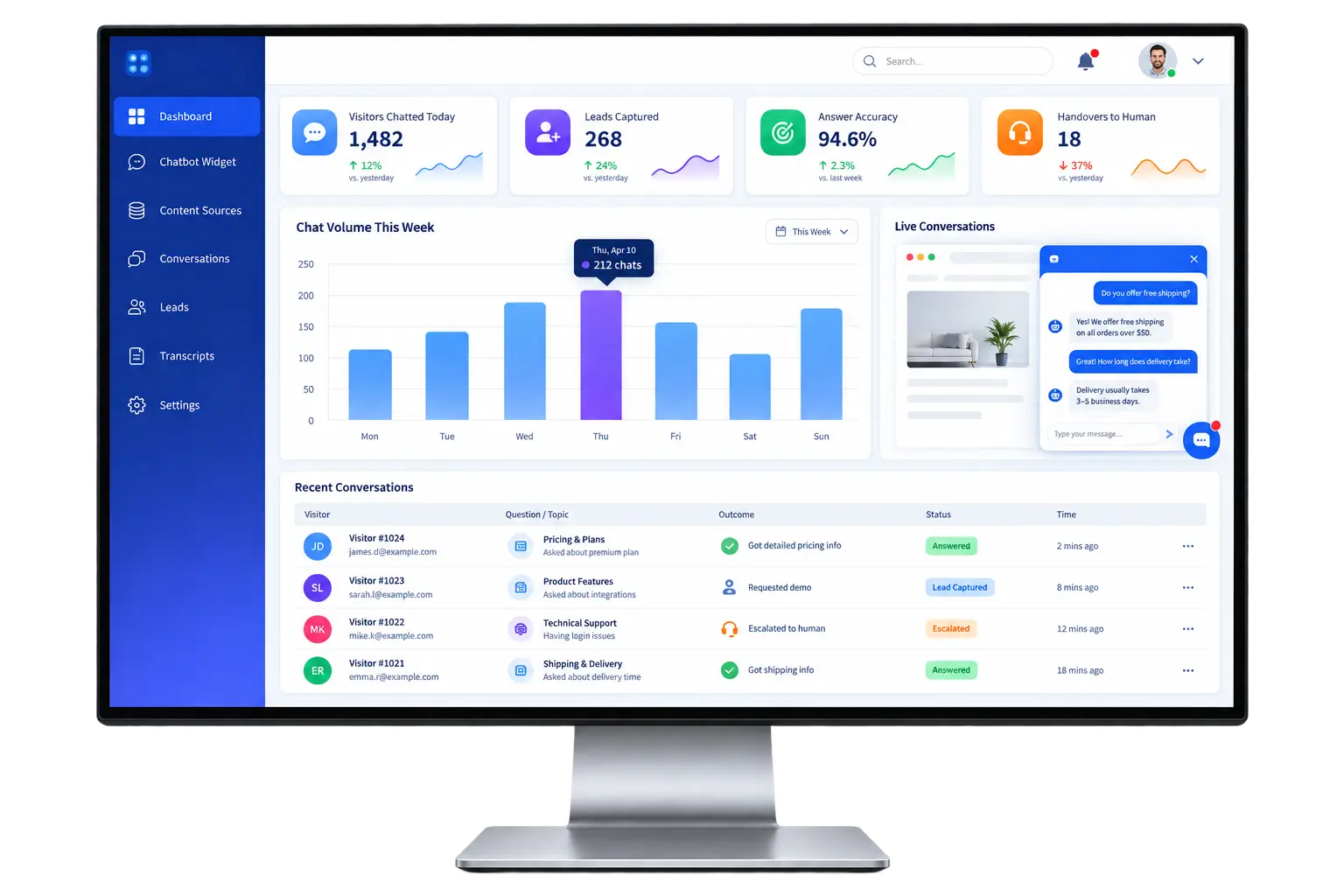
A conversation is not the goal. The chatbot asks for the details you actually need, writes a scored record into your CRM, and books the call or viewing before the visitor leaves the page.
Says What's True, Not What Sounds Good
It answers only from your approved content, refuses to guess at prices or eligibility, and hands over rather than inventing. Whatever your chatbot says, you said — so it is built to be right.
How It Works
How Do You Build an AI Chatbot for a Website?
Four steps. The second one is the one that separates a chatbot you can trust from one you end up switching off after a fortnight.
01
Feed It Your Real Content
We index the material that actually answers questions — service pages, price lists, brochures, FAQs, policy documents, listing data. Not a generic model guessing about your business. This usually surfaces a second finding: the questions people ask most are often the ones your website never answered. That list is worth having on its own.
02
Set the Boundaries
We agree what it must never answer on its own — final pricing, eligibility decisions, medical or legal advice, anything regulated, anything it cannot cite a source for. Then we make it say the honest thing when it does not know: admit it, and offer a person. A chatbot that guesses well is more dangerous than one that guesses never.
03
Wire Up Capture and Handover
We connect your CRM, calendar and notification channels, decide what qualifies as a lead worth capturing, and set the rules for when a live person should take over. Out of hours, the handover routes to whoever should pick it up next — or to your AI receptionist if a call is the better ending.
04
Read the Transcripts Weekly
We go through real conversations with you: what it answered well, what it declined, what people asked that nothing in your content covers. Those gaps become new content — which improves the chatbot and your website's own search performance at the same time.
Feature Capabilities
What It Does on the Page, and What It Refuses to Do
A chatbot's value is not how much it says. It is how much of what it says you would be comfortable seeing quoted back to you by a customer.
Grounded in Your Content
Answers are drawn from your documents and pages, not from general web knowledge. Update a price list and the answers change with it, the same day.
Arabic & English Visitors
Replies in whichever language the visitor types, including mixed threads, with right-to-left rendering that reads properly rather than looking machine-translated.
Lead Capture & Scoring
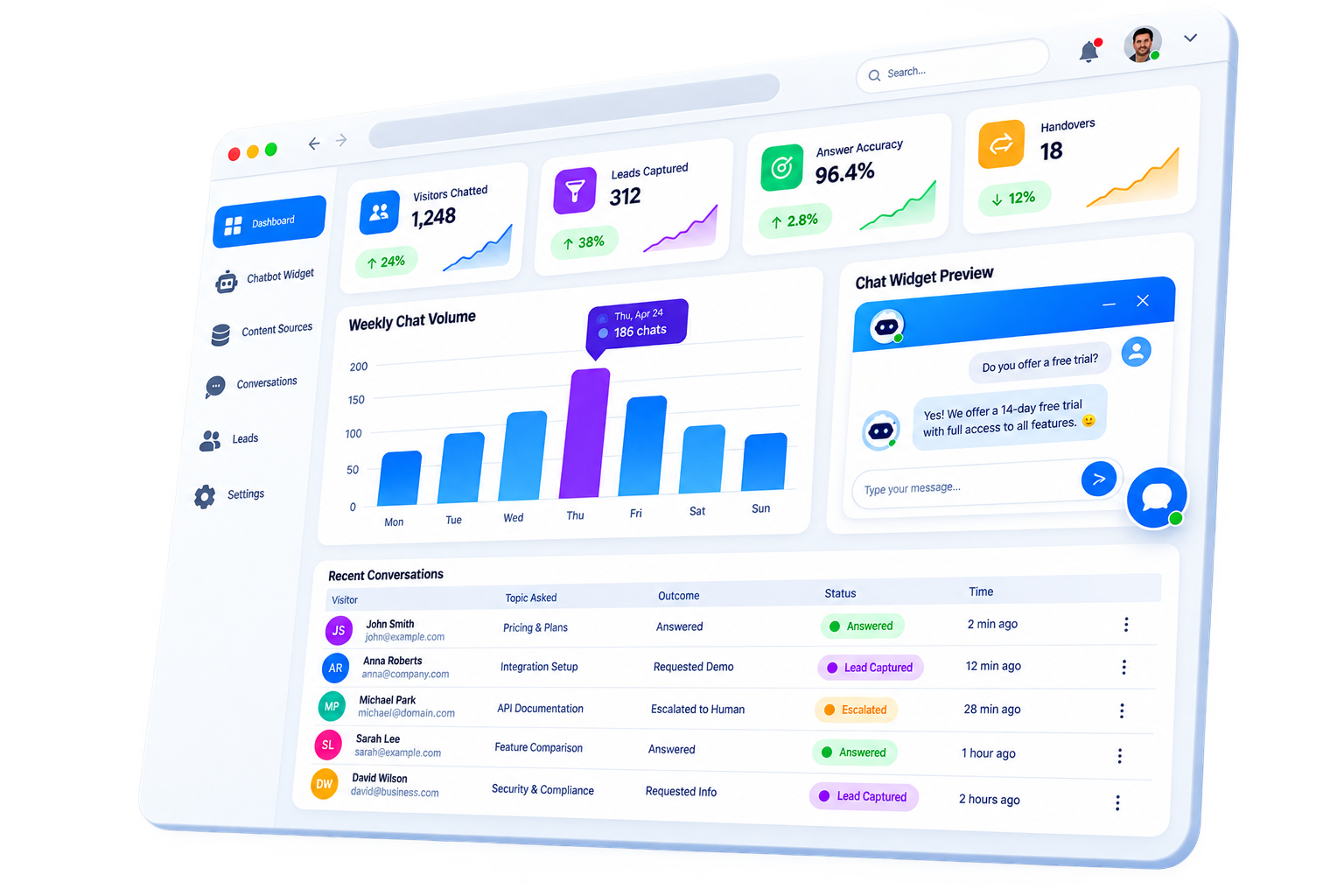
Collects name, requirement, budget and timeline inside the conversation, scores the intent, and writes it to your CRM with the full transcript attached.
Human Handover
Escalates on frustration, a high-value enquiry, an out-of-scope question, or a direct request — with the thread already open for whoever picks it up.
Booking on the Page
Offers real calendar slots inside the chat and confirms them. For full booking depth, durations and no-show recovery, see the AI appointment setter.
Transcripts & Content Gaps
Every conversation logged, with a running report of questions it could not answer — the clearest list of missing website content you will ever get.
Testimonials
From Missed Calls to Booked Viewings
The pattern is consistent across sectors: the calls were always coming in. They were just arriving at 11pm, in Arabic, or fourteen at a time — and landing in voicemail.
We were losing Property Finder leads overnight to whoever called first. Now the callback goes out in seconds and my agents walk in to a diary of confirmed viewings.
Rashid K.
Brokerage Director · Business Bay
Ask It the Question Your Website Never Answers
Give us your site and the five questions customers ask most. We will point a chatbot at your own content and let you try to catch it out — including in Arabic. If it cannot answer them well, we will tell you why.
FAQS
AI Chatbots: Your Questions Answered
What it is, what it costs you if it gets something wrong, and how it fits with the rest of what we do.
An AI chatbot is a widget on your website that holds a real conversation with a visitor. It understands questions written in normal language, answers them from your own content, and turns the useful conversations into contacts, bookings or calls.
It is different from the scripted chat widgets most sites still run, which only offer a menu of buttons and fall over the moment someone types something unexpected. It is also different from live chat, which needs a person available — an AI chatbot answers at 2am on a Friday, which in Dubai is when a good share of property and clinic research actually happens.
Yes, any AI system can be wrong, and the business is responsible for what its chatbot says. This is settled enough to be worth planning around: in Moffatt v. Air Canada (2024), a tribunal rejected the airline's argument that its chatbot was a separate entity and held the company liable for the incorrect information it gave a customer.
The tribunal's reasoning was simple — a chatbot is part of your website, and a visitor is entitled to rely on it without cross-checking another page. So the engineering that matters is not making it clever, it is making it accountable:
- It answers only from content you have approved, not from general web knowledge
- It is blocked from committing on final pricing, eligibility, medical or legal questions
- When it is unsure, it says so and offers a person instead of producing a plausible guess
- Every conversation is logged, so you can see exactly what was said
Any vendor who tells you their chatbot never gets anything wrong is either not paying attention or hoping you are not.
Yes. It replies in whichever language the visitor types, including threads that mix Arabic and English, and the chat panel renders right-to-left properly rather than looking like a translation bolted on.
Your source content does not have to exist in both languages for this to work — the chatbot answers in Arabic from English source material where it needs to. That said, we usually recommend translating your highest-traffic pages properly over time, because it helps your search visibility as well as the chatbot. Hindi, Urdu, Malayalam, Tagalog and Russian are available where your visitors need them.
Three things: access to the content that answers real questions, a decision on what the chatbot must never answer alone, and one person who can approve the wording.
The content can be messy — website pages, PDFs, price lists, brochures, an internal FAQ document, listing feeds. We would rather work from what you actually have than ask you to write something new first. If your material genuinely does not answer the questions customers ask, we will tell you that early, because no chatbot fixes a content problem.
Typical deployment is seven to fourteen working days on any normal website platform, WordPress included.
Yes, with the usual obligations. Under the UAE Personal Data Protection Law (Federal Decree-Law No. 45 of 2021) you remain the data controller for anything the chatbot collects, and we act as processor.
Practically, that means telling visitors what you collect and why, keeping the chat notice and your privacy policy consistent, retaining transcripts only as long as you need them, and being able to delete a person's data on request. We provide the processing agreement and configure retention to your policy. Businesses inside DIFC or ADGM fall under those free zones' own data-protection regimes, which we can accommodate. General information, not legal advice — confirm your position with your counsel.
The chatbot is the conversation layer, and this page is about its home on your website. The same understanding also powers replies inside WhatsApp threads, which is where the other two services come in.
WhatsApp Automation is the workflow layer — what gets sent, when and to whom. WhatsApp Business AI Automation is the platform layer — the official verified number, shared team inbox and approved campaigns. On the voice side, the AI receptionist answers your phone line and the AI appointment setter owns booking depth.
Most businesses start with whichever channel is leaking most. If your ad traffic bounces, start here.